

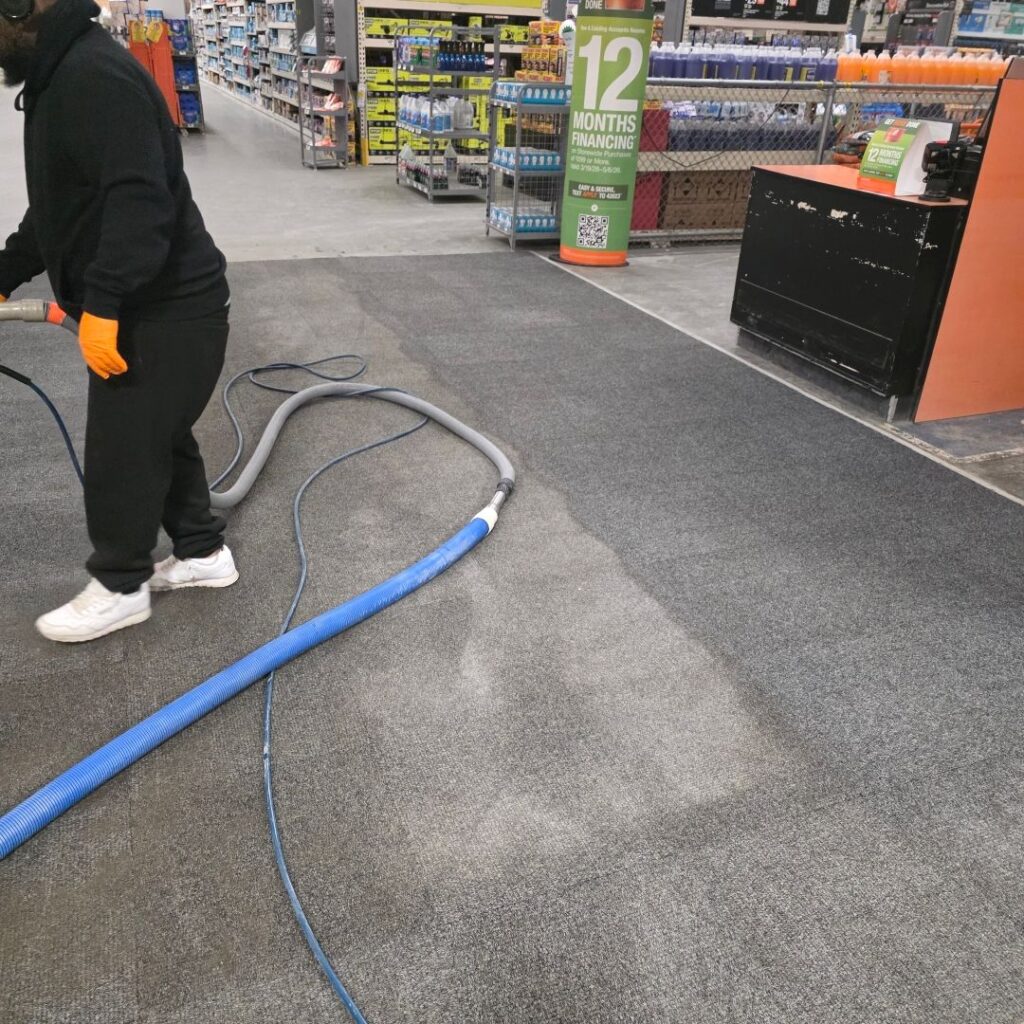
Most buildings buy these two things as one thing, and that is where the trouble starts. A commercial cleaning contract that folds specialist floor work into a nightly janitorial line item almost always produces the same outcome: the daily work gets done, the periodic work quietly does not, and eighteen months later somebody is looking at a lobby floor wondering what happened.
They are different services with different labor, different equipment and different economics. Buying them under one undefined heading is how a facility ends up paying for both and receiving one.
What janitorial actually is
Daily custodial work. Trash removal, restroom servicing and restocking, dusting, spot cleaning, dust mopping and vacuuming, kitchen and break room surfaces, glass at entrances, and general tidying. Usually performed nightly or on a set weekly pattern, by a crew on site regularly, with consumables supplied under the same agreement.
It is high frequency, moderate skill, and its purpose is to hold the building at an acceptable standard between deeper interventions. It is also the tier that determines how well everything else performs, because grit removed nightly is grit that never gets ground into a floor.
What contract floor care actually is
Scheduled specialist work on the floors themselves. Hot water extraction on tile and grout, strip and refinish or burnish cycles on vinyl composition tile, restorative work on stone, machine scrubbing programs, entrance matting service, and periodic soft flooring work.
Low frequency, high skill, equipment intensive. A truck mounted unit, a rotary extraction tool, a propane or battery burnisher and a technician who knows which chemical belongs on which surface are not things a nightly custodial crew carries.
The distinction matters because these two services fail in different ways. Janitorial fails visibly and immediately: the trash is still there. Floor care fails invisibly and slowly, and by the time it is visible the remedy is restoration rather than maintenance.
Why bundling causes problems
Three predictable failure modes.
First, the specialist work gets squeezed by the daily labor budget. When both come out of one price, and the daily work is what anybody notices, the periodic work is what gets deferred when margins tighten.
Second, invisible subcontracting. A janitorial provider without floor equipment subcontracts the periodic work, marks it up, and the building loses direct contact with whoever is actually touching the floors. Nobody in the building can say who did the work or what method they used.
Third, method drift. Without a specified method, a subcontractor optimizes for their own cost. Floor finish gets applied to surfaces that should never receive it. A single mid range chemical gets used on every surface in the building, which is acceptable on almost none of them.
None of that is dishonesty. It is what happens when a contract describes an outcome instead of a scope.
What a floor care scope should name
Surfaces by type and area. Square footage per surface, not per building. Porcelain tile with cement grout, vinyl composition tile, luxury vinyl, sealed concrete, natural stone and soft flooring are six different maintenance obligations and should be listed as six line items.
Frequency by tier. Daily, weekly, periodic and restorative, each with its own frequency per area. A single annual figure hides the tier that actually protects the asset.
Method, not just result. Name the process. Hot water extraction under pressure with contained recovery and neutral rinse is a specification. Deep clean is not. This is the clause that prevents finish being applied to porcelain.
Chemicals and pH suitability. Who supplies them, and a requirement that products match the surface. One line preventing acidic cleaners on calcite based stone will save more money than any other sentence in the document.
Matting. Who supplies entrance matting, how much, and how often it is serviced. In Anchorage this deserves its own clause with a different winter frequency, because saturated matting stops working and starts releasing brine back onto the floor.
Equipment. What is being used, who owns it, and whether the contractor is bringing truck mounted capability or relying on portables.
Access and scheduling. Available hours, notice periods, who holds keys or codes, and how work that needs a longer closure is agreed. Strip and refinish work needs a weekend. Extraction generally does not.
Downtime expectations. How long each area is out of service, and what the reoccupancy condition is.
Reporting. Completion records per visit, photographic evidence where the work is not otherwise visible, and a named contact.
Insurance, screening and access control. Standard, but frequently vague, and worth stating explicitly for anyone working in an occupied building after hours.
Escalation and remedy. What happens when work is unsatisfactory, in what timeframe, and who decides.
Term, review and change of scope. How the agreement is reviewed, how scope changes are agreed and documented, and what notice applies. Commercial terms are a matter between the building and its contractor, but the mechanism for changing them belongs in writing.
The seasonal clause Alaska buildings need
A contract with one frequency for the whole year is wrong in this climate, in both directions.
From roughly October through April, buildings take sand, glacial silt, chloride brine and meltwater on every pair of boots that comes through the door. Entrance zones and primary traffic lanes need more frequent attention, matting needs servicing far more often, and periodic work is best weighted toward late autumn before freeze up and late spring after breakup.
Through the summer, the same building needs meaningfully less. A contract that does not flex is either overpaying in July or underperforming in February.
Winter also affects scheduling in a useful way. Indoor air in a heated Anchorage building is extremely dry through the heating season, so floors dry faster and restorative work fits into shorter windows than it would in summer.
Measuring whether it is working
Scheduled joint walkthroughs against an agreed checklist, with a defect list rather than a general impression. Same route each time, same criteria, recorded.
Photographic records for periodic work, taken before and after in the same positions.
Condition tracking on specific known problem areas: the primary entrance, the busiest traffic lane, the restroom floors. Those three tell you most of what you need to know about whether a program is holding.
What not to measure by: complaints. By the time occupants complain about a floor, the maintenance program failed several months earlier.
One more clause worth having
Emergency response. Water losses in commercial buildings happen at inconvenient hours, and in Anchorage they cluster during cold snaps when every restoration crew in the city is busy. A contract that names a response arrangement, and a contractor who already knows the building, is worth having before you need it rather than after.
How we structure ongoing agreements is set out under contract services, and the wider range of work we do for buildings sits under commercial services. On the soft flooring side, the case for frequency in busy buildings is made in buildings with daily foot traffic and in what actually changes results in Anchorage offices. We have been holding building contracts in this city since 1976, which is covered on our about page. To have a building walked and a scope drafted, get in touch.
Frequently asked questions
What is the difference between janitorial and contract floor care?
Janitorial is high frequency daily custodial work: trash, restrooms, dusting, vacuuming, spot cleaning. Contract floor care is low frequency specialist work on the floors themselves, using equipment and chemistry a nightly crew does not carry, such as hot water extraction on tile and grout or strip and refinish cycles on vinyl composition tile.
Should floor care be bundled into a janitorial contract?
It can be, provided the floor care scope is written out separately inside the agreement with its own surfaces, frequencies, methods and reporting. What causes problems is an undefined bundle, because the periodic work is invisible and is therefore the first thing deferred when the budget tightens.
What frequency should a commercial cleaning contract specify?
Separate frequencies per tier and per area rather than one figure for the building. Daily grit control everywhere, weekly to monthly scrubbing in traffic areas, and periodic deep work two to four times a year in most Anchorage buildings, with entrances and restrooms often warranting more.
How should contract performance be measured?
Joint walkthroughs on a fixed route against an agreed checklist, producing a defect list rather than an impression, supported by before and after photography for periodic work. Occupant complaints are a lagging indicator and should not be the primary measure.
Should a contract account for seasonal change in Alaska?
Yes, and most do not. Soil load from October through April is far higher than in summer, matting needs servicing much more often, and periodic work is best weighted toward late autumn and late spring. A single year round frequency either overspends in summer or underperforms in winter.