

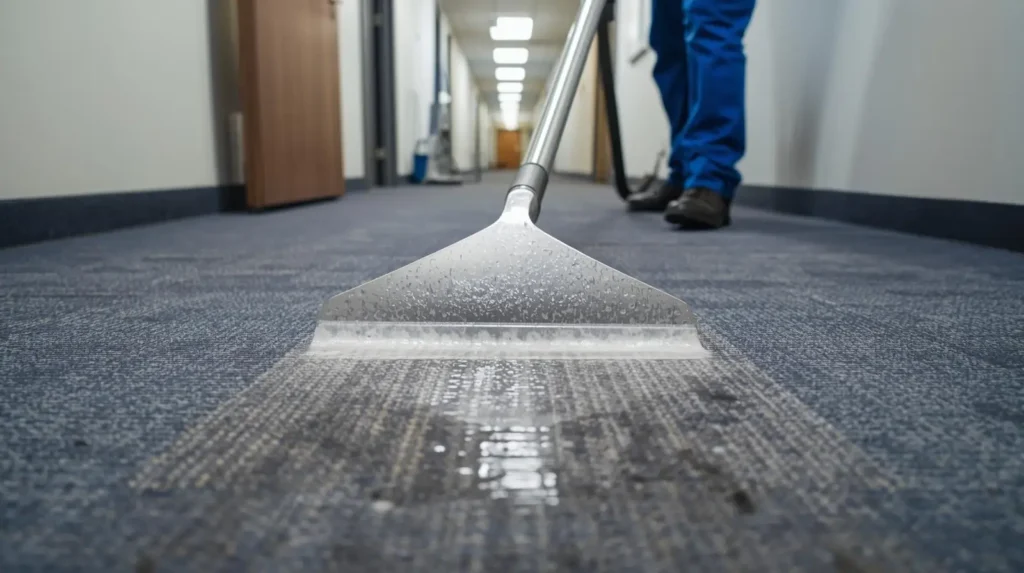
Clean-looking carpet isn’t the point. The point is removing the stuff that destroys carpet fibers, traps odors, and makes an office feel tired—without turning the workspace into a construction zone.
Modern offices in Anchorage put carpets through a specific kind of abuse: gritty winter sand and de-icing residue tracked in for months, spring breakup moisture, shoulder-season mud, and year-round coffee spills and rolling-chair wear. If you’ve ever watched a carpet go from “fine” to permanently gray along traffic lanes in a single season, you’ve seen what happens when surface vacuuming is asked to do a deep-cleaning job.
This guide breaks down what actually changes outcomes in commercial carpet cleaning for offices—what’s happening inside the carpet, why some “cleanings” make things worse, and how professionals adjust methods based on carpet construction, soil load, and building constraints.
The enemy isn’t “dirt” it’s abrasive grit and sticky residue
Office carpet rarely fails because it gets stained. It fails because abrasive particles (sand, fine gravel, mineral grit) work their way down between fibers and get ground in under foot traffic. That friction acts like sandpaper, dulling and fraying fibers until they can’t reflect light evenly—so the carpet looks permanently dirty even right after cleaning.
The second enemy is sticky residue: beverage sugars, drink syrups, tracked-in oils, and some low-quality spot cleaners that leave detergent behind. Residue turns carpet into a magnet. Once fibers are slightly sticky, they hold onto fine particulates more aggressively, and the “re-soiling” curve gets steep.
What improves results isn’t a stronger perfume or hotter water alone. It’s a process that:
- Removes dry particulate first (so you’re not turning grit into muddy slurry),
- Breaks soil bonds with the right pre-treatment chemistry and agitation,
- Extracts thoroughly (so loosened soil actually leaves the carpet),
- Controls residue (so it stays cleaner longer),
- Manages drying (so the office can function and odors don’t develop).
Why office carpets clean differently than residential carpets
Offices tend to use commercial-grade, low-pile carpet or carpet tiles designed for durability and appearance retention. That changes the cleaning game.
- Lower pile, tighter construction: Soil is less visible at first but can pack densely. You need effective agitation and extraction to pull it out.
- Traffic lanes are extreme: Hallways, printer areas, break rooms, reception desks—these zones behave like different “micro-environments” with different soils.
- Rolling chair wear: Casters twist fibers and create gray trails; cleaning has to address both soil and fiber distortion.
- Operational constraints: You can’t have wet carpet under conference rooms at 9 a.m., and you can’t block fire exits or ADA routes.
A good commercial carpet cleaning plan treats an office like a map. It targets zones differently instead of running the same wand pass everywhere and calling it done.
The sequence that changes outcomes
A professional-level result is mostly about sequence and control—not a single magic machine.
1) Dry soil removal is not optional
If you skip a high-quality vacuum step (or do a quick pass with poor suction), you leave behind the abrasive grit that causes the most long-term damage. In Anchorage, winter tracking can load carpets with mineral grit that sits below the surface. When hot water hits that, it becomes a heavy slurry that’s harder to recover.
Effective dry removal means:
- Slow, methodical passes over traffic lanes,
- Edge attention near baseboards and under desks,
- Additional focus at entryways and around break rooms.
2) Pre-spray chemistry has to match the soil
“Office dirt” isn’t one thing. It’s a mix of:
- Particulate soil (sand/silt/mineral),
- Oily soil (skin oils near workstations, tracked-in vehicle oils),
- Food and beverage residues (break areas, reception),
- Spots (ink, coffee, soda, adhesive from tape).
A pre-spray that’s too mild won’t break soil bonds; one that’s too aggressive or left too long can risk discoloration on certain fibers. The right approach is compatible chemistry + dwell time + controlled agitation to loosen soil without damaging carpet or leaving residue.
3) Agitation is where “okay” becomes “actually clean”
Agitation is the overlooked lever. It’s what works pre-spray into the fiber bundle and helps release packed-in soil. In low-pile commercial carpet, light agitation can be the difference between cleaning the top third of the fibers and cleaning the full depth.
4) Hot water extraction works when extraction is real
Hot water extraction (often called “steam cleaning”) is effective for offices when recovery is strong. The goal is not to saturate; it’s to flush loosened soil out and remove moisture on the same pass.
Better outcomes come from:
- Proper water pressure for the carpet type,
- Controlled heat (enough to improve cleaning, not so much it risks issues),
- Multiple extraction passes where needed,
- Strong vacuum recovery to reduce drying time.
If carpets “look better but smell weird” after cleaning, that’s often too much moisture left behind or soil that was loosened but not fully removed.
5) Rinse strategy matters because residue causes rapid re-soiling
Some carpets get dirty fast after cleaning because they were left with detergent residue. A proper rinse approach helps prevent that “clean for a week, then worse than before” cycle.
6) Drying is a performance metric, not an afterthought
In an office, drying time is not a convenience issue—it’s a risk management issue. Longer dampness increases the chance of odor development and can disrupt operations.
Drying improves with:
- Strong extraction,
- Adequate airflow (fans placed strategically),
- Managing humidity in the building,
- Cleaning in zones so the office can function while sections dry.
Carpet type, office layout, and the “traffic lane problem”
If you want a carpet to look consistently good, stop treating the entire floor the same. Treat it like an office uses it.
Entryways and vestibules
These areas take the most grit. If entry mats are too small or not maintained, the carpet becomes the mat. The most cost-effective improvement is often better mat coverage and maintenance, because it reduces abrasive soil before it reaches the carpet.
Hallways and corridors
These are classic traffic lanes. The “gray lane” is a mix of packed soil and fiber wear. Cleaning can remove soil, but worn fibers can still reflect light unevenly. That’s why a realistic goal is:
- Remove packed soil (so wear doesn’t accelerate),
- Improve appearance as much as fibers allow,
- Prevent the lane from getting worse quickly.
Workstations and under-desk zones
These areas collect fine dust, snack crumbs, and spilled drinks that employees quietly blot and forget. They also hide spots behind chairs and under cabinets. Targeted spot work plus thorough extraction makes a big difference here.
Break rooms and coffee stations
This is where sticky residues happen. Coffee, creamer, sugar, and syrups leave behind films that attract soil. A cleaning plan that ignores break-room carpet chemistry is a plan that guarantees rapid re-soiling.
Conference rooms and reception
These are image-critical areas. They often benefit from more careful grooming and controlled drying so the carpet lays evenly and looks uniform.
What “good” looks like after commercial carpet cleaning
A useful way to judge results is to separate appearance from performance:
Appearance outcomes (what you can see):
- Traffic lanes are lighter and more uniform,
- Spots are reduced without obvious “clean circles,”
- The carpet pile is groomed and consistent,
- No crunchy texture from residue.
Performance outcomes (what you feel later):
- Less dustiness in the air around high-traffic zones,
- Less recurring odor in break areas,
- Slower re-soiling over the next few weeks,
- Carpet fibers don’t look increasingly frayed month after month.
If your carpet looks fine for three days and then snaps back to dull gray, you likely have residue, incomplete extraction, or poor dry soil removal—not “impossible carpet.”
The office-safe way to handle spots without making them permanent
Many “permanent stains” are actually permanent damage caused by the wrong spot treatment. Offices commonly make these mistakes:
- Over-wetting a spot and pushing it deeper,
- Scrubbing aggressively and distorting fibers,
- Using high-foaming cleaners that leave residue,
- Using bleach-like products that discolor fiber dyes.
A safer spot approach is:
- Blot first (don’t scrub),
- Use minimal moisture,
- Rinse lightly if a cleaner is used,
- Extract or blot thoroughly to reduce residue.
This matters because spot-cleaner residue can create a visible halo and can accelerate re-soiling around the repaired area.
Planning commercial carpet cleaning around office operations without chaos
The best cleaning plan is one that the building can actually live with. Practical planning looks like:
- Cleaning zones so walkways remain open,
- Scheduling high-traffic areas during low-use windows,
- Prioritizing reception/conference rooms before important events,
- Coordinating with cleaning crews so trash bins, cords, and furniture don’t block equipment.
In Anchorage, seasonal timing matters too. When tracking is at its peak, entry zones may require heavier focus. When humidity shifts, drying strategies may need adjustment.
A closing note on what truly protects office carpet long-term
Office carpets don’t need constant “deep cleaning.” They need smart cleaning that removes grit and residue before fibers wear down, plus practical prevention at the entry points. When commercial carpet cleaning is done with the right sequence—dry removal, correct chemistry, agitation, thorough extraction, residue control, and drying management—the carpet doesn’t just look better. It lasts longer and stays presentable between cleanings in a way surface-only maintenance can’t achieve.