

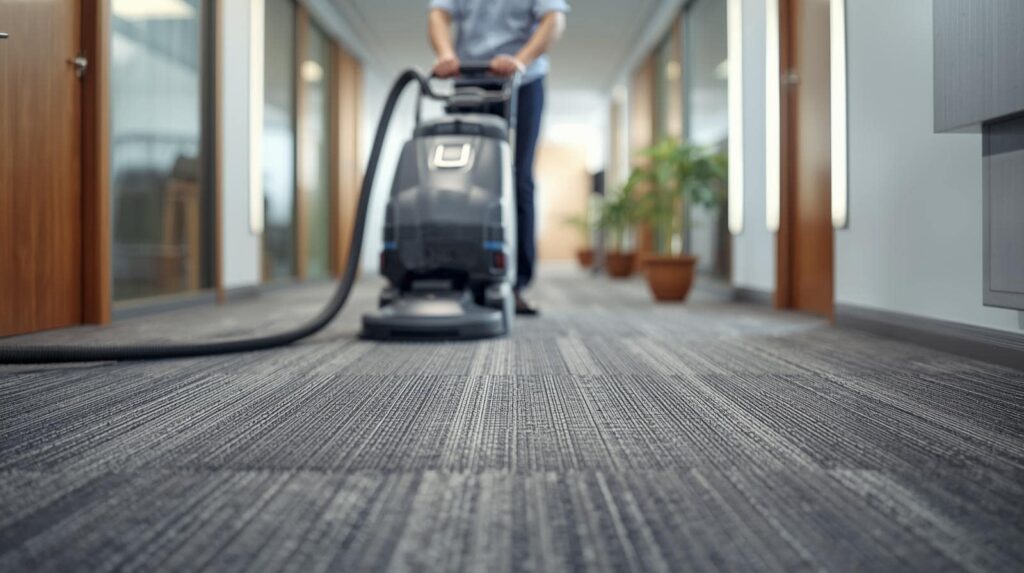
Carpet in a business takes a different kind of punishment than carpet in a home
A residential carpet may deal with family traffic, pets, spills, and ordinary daily use, but commercial carpet cleaning exists for a reason. Carpet in a business environment is exposed to a different level of pressure. Offices, hallways, waiting areas, lobbies, shared workspaces, and customer-facing rooms often deal with constant foot traffic, repeated wear patterns, tracked-in debris, and a much narrower margin for looking neglected.
That changes the entire conversation. In a commercial setting, carpet is not just part of the interior. It is part of the building’s day-to-day performance. It affects how the space looks, how clean it feels, and how well it holds up under heavy use. A carpet that gets crossed dozens or hundreds of times per day does not respond the same way as one in a spare bedroom or lightly used den. It accumulates soil faster, develops traffic lanes sooner, and shows the effects of weak maintenance more quickly.
That is why commercial carpet cleaning matters more in buildings with daily foot traffic. The issue is not only whether the carpet gets dirty. Of course it does. The issue is how fast dirt is pushed into the fibers, how visible wear starts to shape the appearance of the space, and how quickly ordinary maintenance stops being enough on its own.
A lot of businesses underestimate this because they judge carpet the same way a homeowner would. They wait for visible stains, obvious dullness, or complaints about appearance. That is reactive thinking. In commercial spaces, by the time the carpet looks clearly worn out, it has usually been carrying a much heavier load of soil and use for quite a while.
Daily foot traffic changes what carpet holds and how fast it changes
The more people walk across carpet, the faster the carpet changes. That sounds obvious, but many facility managers and business owners still underestimate what daily foot traffic actually does.
In a commercial building, carpet does not just collect occasional dirt. It takes on:
- Tracked-in outdoor soil
- Fine grit from shoes
- Dust from constant movement
- Moisture from weather conditions
- Residue from spills and spot treatments
- Compression from repeated walking patterns
This matters because heavy traffic does not only make carpet dirty. It drives debris deeper into the fibers and wears down the carpet’s appearance more aggressively. Hallways, entrances, break areas, corridors between workstations, waiting rooms, and reception spaces all tend to develop visible signs of use faster than lower-traffic areas.
That is why commercial carpet cleaning matters more in buildings with daily foot traffic. The carpet is under constant pressure, and constant pressure changes the maintenance requirement. A lightly used surface can survive weak upkeep for longer. A high-traffic commercial carpet cannot.
Traffic lanes form because soil and pressure keep hitting the same areas
One of the most obvious signs of heavy commercial use is the appearance of traffic lanes. These are the darker, worn-looking paths that develop where people walk most often. They usually appear in predictable places:
- Main hallways
- Reception walkways
- Entry-adjacent areas
- Paths between desks or offices
- Routes to elevators, break rooms, and conference spaces
Traffic lanes matter because they show how repetitive use affects carpet over time. People do not walk randomly through a building. They follow patterns. When those same patterns repeat every day, the carpet in those areas gets more soil, more compression, and more visible wear than the surrounding space.
This is one reason commercial carpet cleaning matters more in buildings with daily foot traffic. The carpet is not aging evenly. Certain parts of it are absorbing the worst of the building’s movement every single day. If those areas are not maintained properly, they start shaping the appearance of the whole facility.
A business can have clean walls, organized desks, and polished hard surfaces, but if the main carpet lanes look dark and worn, the overall space still feels less maintained. Carpet carries visual weight in commercial interiors, especially in buildings where people move through the same zones constantly.
Commercial spaces do not get the luxury of ignoring appearance for long
In a home, carpet appearance can decline gradually without creating a serious external consequence. In a business, that is rarely true. Commercial environments are judged more quickly and more harshly.
Customers notice reception areas. Clients notice conference rooms. Patients notice waiting spaces. Employees notice the condition of shared work areas, hallways, and break rooms. Even when people are not consciously evaluating the carpet, they are still forming an impression based on how clean and maintained the building feels.
That is why commercial carpet cleaning matters more in buildings with daily foot traffic. The carpet is part of the building’s presentation. In high-use spaces, it does not take long for embedded soil and repeated wear to start affecting that presentation.
This is not about vanity. It is about standards. Commercial buildings are expected to look reasonably clean, organized, and functional. Carpet that looks neglected undermines that expectation quickly, especially in customer-facing or employee-heavy spaces where foot traffic is constant.
High foot traffic pushes soil below the surface, not just onto it
A common mistake in commercial maintenance is focusing too much on what sits on top of the carpet and not enough on what gets pushed into it.
In buildings with heavy daily traffic, soil is not just dropped onto the surface. It is ground into the fibers by repeated foot pressure. That changes the nature of the cleaning problem. The issue stops being simple surface debris and becomes embedded soil.
This happens faster in commercial settings because:
- more shoes cross the same areas
- more outdoor debris gets brought in
- more movement means more pressure on the fibers
- carpet has less recovery time between uses
That is why commercial carpet cleaning matters more in buildings with daily foot traffic. The carpet is constantly being worked over, and that means the dirt problem becomes deeper, not just more frequent.
Routine vacuuming still matters, but it has limits. In busy buildings, it helps with daily upkeep, but it does not erase what repeated traffic is pressing down into the carpet over time. That is why commercial carpet cleaning is not optional maintenance theater. It is part of dealing with how commercial carpet actually functions under heavy use.
Entrances and common areas often create the biggest maintenance burden
Not every commercial carpeted area carries the same load. Some parts of a building take far more abuse than others, especially where outside conditions meet indoor flooring.
The biggest problem areas are usually:
- Entryways
- Reception zones
- Main corridors
- Waiting rooms
- Shared office paths
- Transitions between exterior and interior spaces
These areas face a combination of problems: outside debris, moisture, frequent crossings, and constant visual exposure. They are also the places where businesses are most likely to be judged by customers, visitors, or staff.
That is another reason commercial carpet cleaning matters more in buildings with daily foot traffic. The highest-traffic areas are usually also the most visible. When those areas decline, the building’s overall appearance declines with them.
Ignoring this is one of the most common facility mistakes. Businesses often spread attention too evenly instead of recognizing that certain carpeted areas are under much heavier stress and need more serious maintenance support.
Daily foot traffic creates a maintenance problem, not just a cleaning problem
A lot of businesses think about carpet cleaning as an occasional response to visible dirt. That is too narrow. In a commercial building, carpet under daily foot traffic is a maintenance issue, not just a cleaning issue.
That distinction matters because maintenance is about preserving performance over time. If carpet in busy areas is constantly absorbing dirt, compression, and wear, then waiting until it looks obviously bad is not maintenance. It is delayed reaction.
Commercial carpet cleaning matters more in buildings with daily foot traffic because those buildings need a system for handling accumulation before it becomes deeply established. The carpet is under too much regular use to rely only on occasional visual intervention.
This is especially true in businesses where:
- customer experience matters
- shared spaces stay active all day
- employees move constantly between rooms
- weather brings in extra debris or moisture
- carpet covers a large portion of the interior
The more the building depends on carpeted flooring in active spaces, the more important it becomes to treat cleaning as part of facility upkeep, not as an afterthought.
Spots and spills are harder to manage in buildings that never really stop moving
Commercial carpet does not only face traffic. It also faces interruptions. Coffee spills in offices. Drinks get dropped in waiting areas. Dirt gets tracked in during bad weather. Staff may notice a spot quickly, but the same area can still be crossed repeatedly before deeper cleaning happens.
That is one reason commercial carpet cleaning matters more in buildings with daily foot traffic. A busy building does not pause conveniently for cleanup. Incidents happen while the space is still being used, and that makes it easier for spots to spread, settle, or become more noticeable.
This creates a more demanding environment than residential carpet care. In a home, a spill may happen in a room that can be avoided for a while. In a commercial setting, the affected carpet often remains in active circulation. That makes timely, effective cleaning more important, because the carpet has less chance to recover before more use stacks on top of the problem.
Employee spaces matter too, even when customers do not see them
Businesses often focus on public-facing areas first, and that makes sense. But commercial carpet cleaning also matters in internal spaces that support daily operations.
Offices, hallways behind the front desk, staff break rooms, meeting spaces, and shared work areas all face regular foot traffic. Employees may not comment on carpet condition every day, but they still work in the environment it helps create. Carpet that looks neglected affects how clean and maintained a workplace feels, even when the people seeing it most are staff rather than customers.
That is another reason commercial carpet cleaning matters more in buildings with daily foot traffic. The impact is not limited to appearances for outsiders. It also affects the quality and professionalism of the environment employees work in every day.
A business that ignores back-of-house carpet condition often ends up with a building that feels inconsistently maintained. The front may look acceptable while internal areas quietly decline. In high-traffic facilities, that gap does not stay invisible forever.
Commercial carpet ages faster when routine care is expected to do too much
Routine vacuuming and spot response are necessary, but they are not enough on their own in buildings with heavy daily traffic. That is where some businesses get the logic wrong. They assume that because carpet gets basic upkeep, deeper cleaning can be delayed indefinitely.
That approach fails because daily care is designed to manage surface-level upkeep, not fully reverse the effects of constant traffic. Once soil becomes embedded and traffic lanes become established, the carpet is carrying more than routine maintenance can remove.
Commercial carpet cleaning matters more in buildings with daily foot traffic because heavily used carpet ages faster when deeper maintenance is neglected. The result is not just a dirty-looking floor. It is a carpet that loses appearance, freshness, and performance sooner than it should.
This is especially true in buildings where carpet covers long corridors, open office areas, or heavily used common spaces. The more surface area exposed to repeated use, the more obvious the limits of basic upkeep become.
High-traffic buildings need carpet care that reflects how the space is actually used
One of the weakest approaches to commercial carpet is pretending all rooms need the same level of attention. They do not. A lightly used conference room is not the same as a lobby. A side office is not the same as the path between the entrance and the reception desk.
Commercial carpet cleaning matters more in buildings with daily foot traffic because the maintenance needs are shaped by real use patterns. The carpet should be evaluated according to:
- where people walk most often
- which areas face outside debris
- which spaces carry the most visual importance
- which rooms stay active throughout the day
- where soil builds up faster than routine care can handle
That is a more honest way to think about facility carpet care. Not all carpet is under equal pressure, and high-traffic carpet should not be treated like it is.
Carpet in busy commercial buildings needs more than visual rescue
The mistake businesses make most often is waiting until the carpet looks bad enough to justify action. By then, the carpet has usually been carrying deep soil, traffic wear, and repeated buildup for longer than anyone wanted to admit.
That is why commercial carpet cleaning matters more in buildings with daily foot traffic. The carpet is part of the building’s daily operation, appearance, and maintenance burden. It is affected by the repeated movement of staff, customers, patients, visitors, and vendors. It loses condition faster because it is asked to do more every day.
In high-traffic buildings, commercial carpet cleaning is not just about fixing what people can see. It is about responding to the demands placed on the carpet before those demands turn into a consistently worn-looking environment. Entrances, hallways, waiting rooms, offices, and shared spaces all reveal the same truth: the more a building relies on carpet under daily use, the more important it becomes to maintain that carpet with the realities of commercial traffic in mind.
Serving Anchorage? See our Anchorage carpet cleaning page for local service details.