

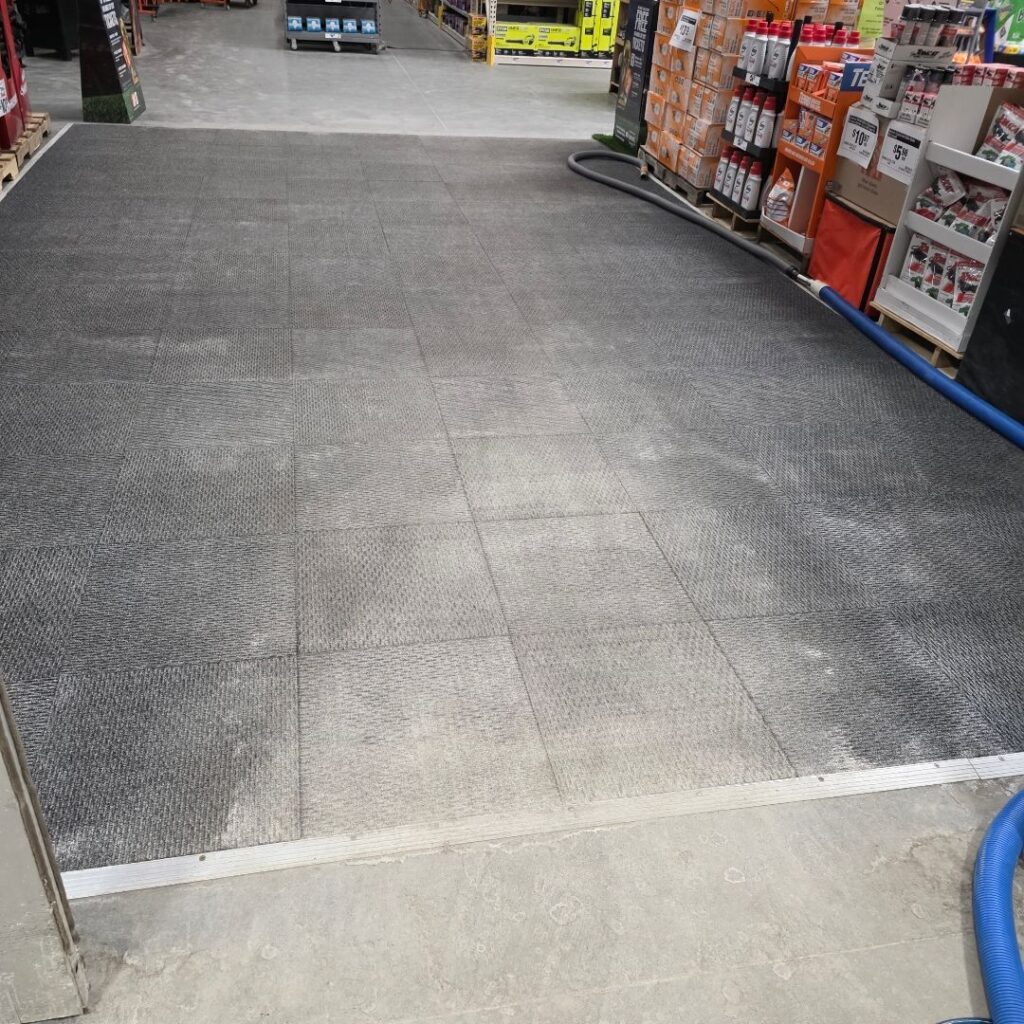
Most Anchorage offices run hard floor maintenance on a single setting: a nightly mop and an annual panic when the lobby starts looking rough. That approach costs more than a structured program, and the reason is straightforward. Soil that is allowed to embed has to be removed with labour and equipment. Soil that is stopped at the door costs nothing to remove because it never arrives.
Commercial floor maintenance in Anchorage is a different problem from the same job in Seattle or Phoenix. Seven months of sand, brine and meltwater arriving on every pair of boots changes the arithmetic of every decision below.
The four tier model
Any workable program separates into four tiers with different frequencies, different labour rates and different equipment. Confusing them is where most facilities budgets go wrong.
Daily. Dust mopping or vacuuming to remove abrasive grit, spot mopping of spills, and mat servicing. Low skill, high frequency, and the tier that determines how well everything above it performs. Grit left on a floor overnight gets ground in the next morning.
Weekly to monthly. Damp mopping with a neutral cleaner and clean solution, and auto scrubbing on larger areas. The key variable is solution change frequency. A scrubber running dirty water is redistributing soil, not removing it.
Periodic. Deep restorative cleaning: hot water extraction on tile and grout, or strip and refinish on floors with a coating. Two to four times per year in most Anchorage commercial settings, with the schedule weighted toward late spring after breakup and late autumn before freeze up.
Restorative. Grout color sealing, honing on stone, or replacement. Rare, planned, capital rather than operating.
When a facility is unhappy with its floors, the fault is nearly always in the daily tier, and the response is nearly always to buy more periodic work. That fixes the symptom for six weeks.
Matting is the cheapest square footage in the building
The trade rule of thumb is that a properly designed entrance matting system runs roughly fifteen feet from the door: a coarse scraper section outside, a scraper and wiper transition immediately inside, and an absorbent wiper section beyond that. Most Anchorage entrances run three to six feet and then wonder why the lobby tile is gray.
Fifteen feet is not always achievable in an existing lobby. The principle still holds: every additional foot of matting removes soil that would otherwise be removed by labour further into the building, at a much higher unit cost.
Winter matting also has to be serviced far more often than summer matting. A saturated mat stops working, and worse, it becomes a source, releasing brine back onto the floor as people walk across it. Extraction cleaning of entrance mats through the winter months is not optional in this climate.
Know what the floor is before choosing a method
Four surfaces dominate Anchorage commercial interiors and they want opposite treatment.
Porcelain and ceramic tile with cement grout. The tile is essentially inert. The grout is the maintenance item. It is porous, it holds soil, brine and detergent residue, and no amount of mopping recovers it once it has loaded up. Periodic hot water extraction under pressure with a contained spinner tool is the correct tool. The mechanics are the same ones described in why mopping is not enough on tile and grout, just at building scale.
Vinyl composition tile. Porous, soft, and only ever protected by the floor finish applied on top. VCT lives on a strip and refinish cycle: burnishing between, full strip and recoat annually or semi annually depending on traffic. Neglect it and the finish wears through to bare VCT, which stains permanently and cannot be recovered by cleaning.
Luxury vinyl tile and plank. Increasingly common in office refits and frequently mismanaged, because crews treat it as VCT and apply floor finish to it. Most LVT is designed to be maintained without a coating. Applying finish creates a permanent maintenance obligation the building did not need.
Polished or sealed concrete. Common in warehouse, service bay and newer open plan space. Densified polished concrete needs neutral cleaning and periodic re polishing rather than any coating. Deicer is genuinely damaging to concrete, and a service bay that takes vehicles in off Anchorage roads all winter carries a heavy chloride load.
The restroom problem
A restroom that still smells after nightly mopping almost always has a grout problem, not a fixture problem. Grout at the base of urinals and toilets absorbs urine over years. It becomes a reservoir. Every time the floor is mopped, the moisture reactivates what is in the grout and the odor returns within an hour.
Mopping makes this worse, not better, because the mop moves contaminated solution across the floor and pushes it into the grout at the perimeter. The remedy is extraction that flushes the grout and removes the contamination, followed by sealing so it cannot reload. Where the grout is beyond recovery, replacement of the grout in the affected zone is the honest answer.
Slip resistance is a liability question
Wet hard floors and winter meltwater are a predictable combination in an Anchorage lobby, and the traction of the floor is affected by what maintenance leaves on it. Detergent residue and over applied or improperly cured floor finish both reduce traction. So does polishing a floor to a level of gloss the specification never called for.
Two practical points. First, a floor that is genuinely rinsed rather than mopped with recycled solution performs better underfoot. Second, wet floor signage and mat coverage during the melt hours of a winter day are operational controls that belong in the cleaning specification, not left to the individual on shift.
Scheduling around a working building
Periodic hard floor work is disruptive if scheduled badly and nearly invisible if scheduled well. Hot water extraction on tile leaves a floor walkable within roughly half an hour and fully dry within a few hours, which makes an evening or weekend slot straightforward. Strip and refinish on VCT is a different matter: multiple coats, each needing cure time, and a floor that should not take traffic until the finish has hardened. That is a full weekend job in most buildings.
Anchorage winter offers one genuine scheduling advantage. Indoor air is extremely dry from November through March, often in the teens for relative humidity, so floors dry faster than they do in summer. Scheduling restorative work in the heating season shortens downtime.
Writing it into a contract
A hard floor specification that works names the surfaces by type and area, states the frequency for each tier, names the method rather than the outcome, and defines who supplies and services the matting. Vague language about keeping floors clean produces vague results, and it makes it impossible to tell whether the building is getting what it pays for.
How that fits into a broader building specification is covered under contract services, and the full range of what we handle for commercial buildings sits under commercial services. Buildings with mixed flooring generally schedule hard surface and soft flooring together, and the case for that in high traffic space is made in our piece on daily foot traffic buildings. Where a floor may be past recovery, the framework in cleaning against replacement is the right starting point. We have been maintaining floors in this city since 1976, which is set out in more detail on our about page. To have a building walked and a specification drafted, get in touch.
Frequently asked questions
How often should commercial tile and grout floors be deep cleaned?
Two to four times a year for most Anchorage office and retail space, weighted toward late spring after breakup and late autumn before freeze up. Entrances, restrooms and food service areas often justify quarterly attention. Low traffic back of house areas can stretch to annual.
Can porcelain tile be stripped and waxed?
It should not be. Porcelain does not need a coating and finish applied to it tends to fail in traffic lanes, at which point the building has inherited a stripping obligation it never needed. Floor finish belongs on vinyl composition tile, not on porcelain and generally not on modern luxury vinyl either.
Why do restroom floors still smell after daily mopping?
Because the source is in the grout, not on the tile. Grout around fixtures absorbs contamination over years and releases odor every time it is re wetted. Mopping reactivates it. Extraction that flushes the grout, followed by sealing, addresses the reservoir rather than the symptom.
How much entrance matting does a building actually need?
The trade rule of thumb is roughly fifteen feet in total, split between an outside scraper section, an inside scraper and wiper transition, and an absorbent wiper run. Few Anchorage entrances achieve that, but every additional foot removes soil at a lower cost than removing it from inside the building later.
Can hard floor work be done outside business hours?
Yes, and it usually should be. Tile extraction fits comfortably into an evening or weekend window because the floor is walkable within about half an hour. Strip and refinish work on vinyl composition tile needs a longer closure because each coat has to cure before traffic returns.