

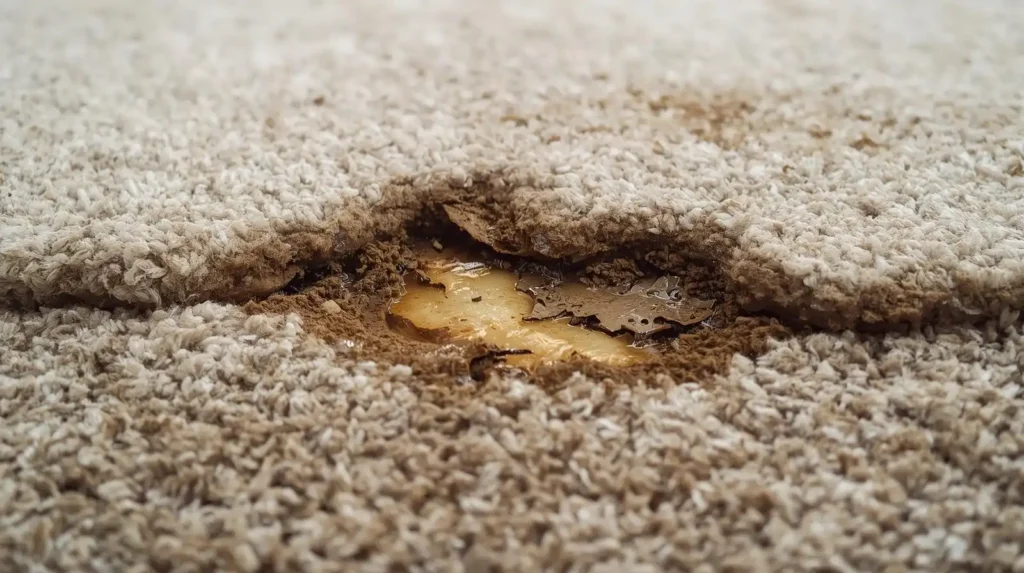
Water damage changes the odor problem from “something spilled on the surface” to “contamination moved into the carpet system.” Once moisture reaches the backing and padding, odors can persist even after the carpet looks dry and clean—because the source isn’t only in the visible fibers anymore.
This guide explains what’s different about odor removal for carpets after water damage, why smells often return, and what determines whether a carpet can be restored or has crossed the line where replacement is the more realistic outcome.
Why water-damaged carpet odors are harder than normal carpet odors
Typical carpet odors (food, drink, general mustiness) often come from residues in the upper fibers. Water damage odors often come from depth and spread:
- Water wicks laterally through the carpet backing
- Padding acts like a sponge and holds moisture longer than the surface
- Contaminants can migrate and redistribute as the carpet dries
- The subfloor can contribute odor if it absorbed water
That’s why a carpet can feel dry on top and still smell “off.” The odor source may be trapped below the surface where household airflow and surface cleaning don’t reach.
The carpet is a system, not a layer
To understand odor removal after water damage, stop thinking “carpet” and start thinking “carpet system”:
- Face fibers (what you see and vacuum)
- Backing (holds structure)
- Padding (absorbs and retains moisture)
- Subfloor (wood or concrete beneath)
Odors persist when moisture and contamination remain in any of these lower layers, especially padding.
What kind of water damage happened matters
Odor removal depends heavily on what the water carried into the carpet.
Clean water exposure
Examples: a supply line leak, an overflowing sink with clean water, rain intrusion without obvious contamination.
These events can still create odor if drying is slow, but restoration odds are often better because the water starts cleaner.
Dirty or contaminated water exposure
Examples: groundwater intrusion, dishwasher discharge with food waste, sewage-related events.
Contaminated water introduces bacteria and organic material that can embed in padding and backing, making odor control much more difficult and sometimes making restoration unrealistic.
Even without naming categories, the practical point is: the “cleanliness” of the water is a major predictor of odor persistence.
Why “drying” alone doesn’t solve the odor
People often focus on drying because wet smells are obvious. But odors can remain even after everything feels dry because:
- Residues remain: minerals, soils, organic matter left behind when water evaporated
- Microbial activity occurred while it was wet: even if the moisture is gone, byproducts can linger
- Wicking concentrates contamination: as moisture moves upward during drying, it can bring odor sources to the surface and edges
- Padding held moisture longer: the surface dried first, but the pad stayed damp and developed odor
That’s why odor removal after water damage usually requires a combination of extraction, cleaning, and controlled drying—not just time and fans.
What changes in professional odor removal after water damage
When the backing and pad are affected, effective odor removal generally involves different priorities than a normal cleaning.
1) Moisture detection and mapping
Water damage is rarely uniform. Odor problems show up later where moisture stayed the longest—often along edges, under furniture, or in low-airflow zones.
A professional approach tends to treat the carpet like a map:
- Where did water travel?
- Where is moisture likely trapped?
- Where is contamination concentrated?
2) Aggressive extraction early
The fastest way to prevent long-term odor is removing as much water as possible before it spreads and before padding stays wet for hours or days.
If extraction is weak, moisture remains in the system and odor risk rises sharply.
3) Cleaning that targets what water left behind
Once water evaporates, it doesn’t leave “nothing.” It leaves whatever it picked up:
- Soil particles
- Minerals
- Organic residues
- Possible contaminants depending on the source
The odor removal goal becomes: remove the remaining load, not just remove the moisture.
4) Controlled drying, not “let it air out”
Drying is most effective when it’s controlled:
- Air movement across the affected areas
- Humidity management so evaporation continues
- Enough time to fully dry the backing/pad, not just the surface
Fast surface drying with trapped moisture underneath is a common setup for odor return.
The pad problem: why padding is often the odor “memory”
Padding is designed to cushion and absorb impact—so it also absorbs water. When padding gets wet, it can:
- Hold moisture far longer than the carpet fibers
- Trap residues and contamination
- Release odor as humidity rises later
This is why “the carpet smells fine on dry days but smells musty on rainy days” is a thing. Humidity can reactivate odor compounds trapped below.
In many cases, the biggest determinant of success isn’t how the carpet looks—it’s what happened to the pad.
Common odor patterns after water damage and what they usually mean
Different smells often signal different underlying issues:
- Musty / damp basement smell: prolonged dampness, incomplete drying, trapped moisture below surface
- Sour smell: organic residue and slow drying, often around padding saturation zones
- Earthy smell after intrusion: soil contamination carried in with water
- Sharp or “chemical” smell after DIY: heavy product residue interacting with leftover contamination
These aren’t perfect diagnostics, but they point to the same theme: odor isn’t just air—it’s a material problem.
Why odor comes back weeks later
Two mechanisms make “it came back” common:
Wicking and edge migration
As remaining moisture evaporates, it can bring dissolved contaminants upward or toward edges. The stain/odor seems gone when wet, then reappears as it dries.
Humidity reactivation
Even after drying, residues in the backing/pad can re-release odor when humidity rises. That’s why some water-damaged odor complaints are seasonal or weather-linked.
When restoration is realistic and when it’s not
This is where people waste time and money by insisting on the wrong outcome.
Restoration is more realistic when
- Water was relatively clean
- Drying and extraction happened quickly
- Padding didn’t stay wet long
- Odor is mild and localized
- There’s no ongoing source (like a recurring leak)
Replacement becomes more realistic when
- Water was contaminated
- Padding and subfloor were saturated and stayed wet
- Odor is strong, widespread, and persistent
- The carpet repeatedly smells worse after attempted cleaning
- There’s structural damage or persistent moisture issues
“Replace vs restore” isn’t a moral decision. It’s a cost-risk decision: how likely is success, and what happens if you sink more time into a carpet that will keep smelling?
The hidden risk: treating odor without fixing moisture
If moisture remains, deodorizing is a temporary mask. Even if a product knocks down smell, trapped dampness and residues can produce odor again.
That’s why the most reliable odor outcomes follow a sequence:
- Remove water (extraction)
- Remove contamination (cleaning/rinsing)
- Dry fully (controlled drying to the depth)
- Confirm stability (no odor rebound with normal humidity)
After water damage, odor removal for carpets depends less on “how hard you clean” and more on whether the odor source is trapped in the backing, padding, or subfloor—and whether moisture was removed fast enough to prevent long-term odor formation.
If the pad and lower layers were affected, successful odor control is a systems job: extraction, contamination removal, and drying that reaches the depth where the odor lives. That’s the difference between a carpet that smells better for a day and a carpet that stays stable through the next humidity shift.