

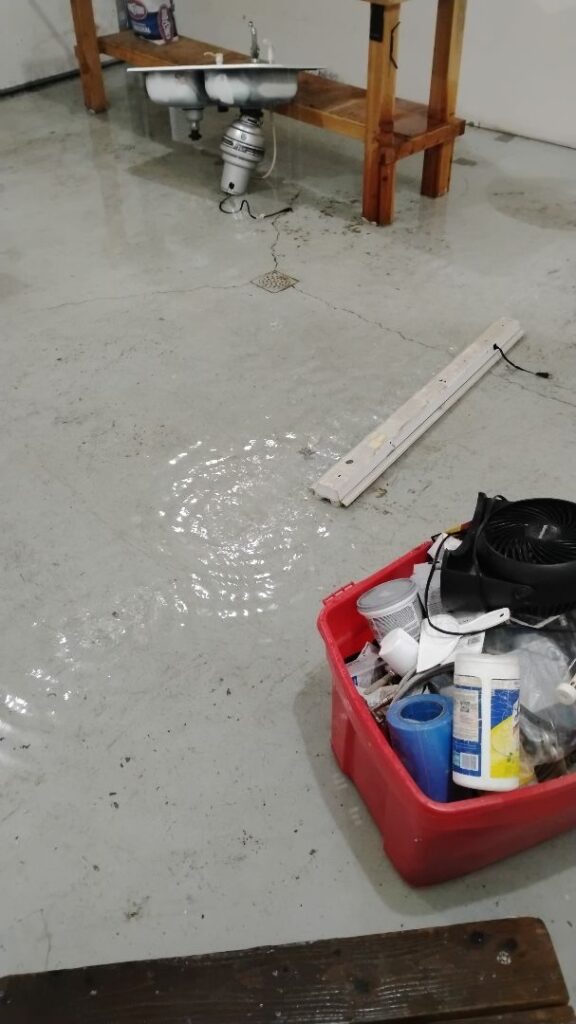
Two things get said about mold after water damage and both of them are unhelpful. The first is that Alaska is too cold for it, which is wrong. The second is that any moisture means catastrophe, which is also wrong and usually said by someone selling something.
The useful version is narrower. Growth needs specific conditions, those conditions are measurable, and the whole point of a properly run drying job is to remove one of them before growth starts. Here is what the conditions are, what a documented dry standard means, and how long the work actually takes in an Anchorage house.
One boundary before anything else. This piece covers building materials and drying practice. Questions about health effects belong with a physician or with public health authorities, not with a cleaning and restoration contractor, and nothing here should be read as medical advice.
What growth actually requires
Four things have to be present together.
Moisture in or on a material. This is the only one of the four a restoration crew can realistically remove, which is why drying is the entire strategy.
Food, meaning organic material. Paper facing on drywall, wood framing, subfloor, dust in a cavity, natural fibers. Concrete and steel are not food. What is layered on them often is.
Temperature in a range that overlaps almost exactly with the range humans keep buildings at. This is the reason the Alaska is too cold argument fails: the outside may be at 10 degrees, but the inside of the wall behind a warm room is not.
Time. The variable that everything in restoration practice is organized around.
The 24 to 48 hour window and what it really means
Restoration industry guidance commonly treats the first 24 to 48 hours after a water loss as the period in which growth can begin on wet organic materials under favorable conditions. That framing is why emergency response exists as a service and why crews work through the night.
Treat it as a planning window rather than a countdown clock. Whether growth begins within it depends on the material, the temperature, how thoroughly the material is wetted, and what the water carried with it. Some assemblies stay clear well past 48 hours. Others do not.
The practical consequence is the same either way. Start drying immediately, and do not accept a schedule where equipment arrives on day three because that was the first convenient slot.
Why Alaska does not get a pass
The cold is outside. Buildings here are sealed tight and heated hard, which produces exactly the interior conditions growth needs, and the heavy insulation that makes an Anchorage house efficient also means a wet cavity is very slow to dry on its own.
The vapor barrier is the specific complication. Polyethylene on the warm side of a wall is doing its job when it stops moisture moving through the assembly. Once water is behind it, that same barrier prevents the cavity from drying outward, so a wall can hold moisture for weeks while the room in front of it feels perfectly normal.
Crawlspaces are the other Alaska specific risk. Cool, dark, poorly ventilated in winter once the vents are closed, and often holding a ground barrier that water sits on top of rather than draining through.
The one genuine local advantage is winter air. Indoor relative humidity in a heated Anchorage home regularly runs down in the teens, and once a wet space is warm, that dryness pulls moisture out of materials fast. Cold air does not dry anything. Warmed cold air does.
Where the problem hides
Rarely in the middle of a room. Almost always in the places nobody looks.
Inside exterior wall cavities behind an intact vapor barrier. Under flooring assemblies, particularly where an impermeable floor covering sits over a wet subfloor. Behind cabinet toe kicks, which trap water and have no airflow at all. Inside saturated fiberglass batt in a closed cavity. In crawlspaces, on the underside of subfloor and on the ground barrier. Behind and beneath built in furniture that was never moved during the response.
This is the same gap between visible and actual that makes moisture mapping non negotiable, described in hidden moisture rather than visible water.
What a dry standard actually is
This is where most homeowners are left in the dark, and it is the single most useful thing to understand.
A material is not dry because it feels dry. It is dry when its moisture content matches that of the same material in an unaffected part of the same building. So on day one a technician takes reference readings: the same species of framing, the same subfloor, the same drywall, in an area the water never reached. Those readings become the target.
Then affected materials are measured daily against that target, with the readings written down. Air temperature and relative humidity inside the drying chamber get recorded too, because they tell you whether the system is working or just running.
What this gives you is a file that demonstrates the structure reached a dry standard. That matters for the building, and it matters later if anyone asks what condition things were left in. A crew that cannot show you daily readings is not running a drying job, it is running fans.
Realistic timelines
For a contained loss on a main floor, caught early, with clean water: three to five days of equipment is normal.
Where water reached wall cavities and the vapor barrier had to be opened, or where flooring was left in place and is drying through an assembly, expect longer. A week is common.
Crawlspace work runs longest. The space usually has to be heated before drying can begin at all, and once heat is established the drying itself proceeds from a cold start.
Two warning signs. A crew that promises to be finished tomorrow on a substantial loss is guessing rather than measuring. And a crew that pulls equipment on a fixed schedule rather than on readings is optimizing for its own logistics.
If growth is already visible
The job changes character. It is no longer only a drying exercise.
Standard practice is containment of the affected area, negative air pressure so contaminated air does not travel through the rest of the building, HEPA filtration, controlled removal of porous materials that cannot be cleaned, and cleaning of the remaining surfaces. Drywall and saturated batt insulation with growth on them are generally removed rather than treated in place, because porous materials do not clean reliably.
For anything beyond a small isolated area, an independent indoor environmental professional is the right call. The person assessing the extent of a problem should not be the person paid to remediate it, and third party post remediation verification is how a homeowner gets an answer they can rely on. Any contractor who resists that arrangement has told you something.
Keeping it from starting
Most of it is building operation rather than anything dramatic.
Run bathroom extract fans during and after showers and make sure they vent outside rather than into an attic. In a house where winter indoor air is otherwise very dry, the bathroom is the one room generating serious moisture.
Watch humidity if you run a humidifier through the heating season. Comfortable is one thing, condensation on windows is a signal you have gone too far.
Keep a crawlspace ground barrier intact and check it after any work down there.
Deal with small leaks immediately. A slow supply line drip behind a cabinet is worse than a burst pipe, because nobody finds it for months.
The general immediate steps after a loss are in what to do with water damage, and the broader background on this topic is in our newsletter piece on why mold matters. Our emergency response runs through flood and water restoration, the repair phase afterwards through flood damage repair and restoration, and more of our restoration writing sits in the restoration archive. To have a property assessed, reach us here.
Frequently asked questions
How quickly can mold start growing after water damage?
Restoration industry guidance commonly treats 24 to 48 hours as the window in which growth can begin on wet organic materials under favorable conditions. Whether it does depends on temperature, how thoroughly the material was wetted and what the water carried. Treat it as a reason to start drying immediately rather than as a fixed deadline.
Does cold weather stop mold growth?
Outdoor cold does not protect the inside of a heated building. Wall cavities, floors and crawlspaces behind and beneath warm rooms sit in a temperature range that supports growth. Alaska construction is also heavily insulated and vapor sealed, which means a wet cavity dries far more slowly on its own than it would in a lighter built house.
How do I know the structure is actually dry?
By comparison, not by touch. A technician records reference readings from the same materials in an unaffected part of the building, then measures affected materials daily against that target. Ask for the daily monitoring log. If nobody can produce one, nobody can demonstrate the building reached a dry standard.
Should I get air testing done?
For anything beyond a small isolated area, an independent indoor environmental professional is worth engaging, and post remediation verification should be done by someone other than the contractor performing the work. Keeping assessment separate from remediation is what makes the result meaningful.
Can wet drywall and insulation be saved?
Sometimes drywall can be dried in place when the water was clean and the response was fast, particularly if the cavity is opened so air can reach it. Saturated fiberglass batt in a closed cavity is normally removed. Where visible growth is present on porous materials, standard practice is removal rather than surface treatment.