

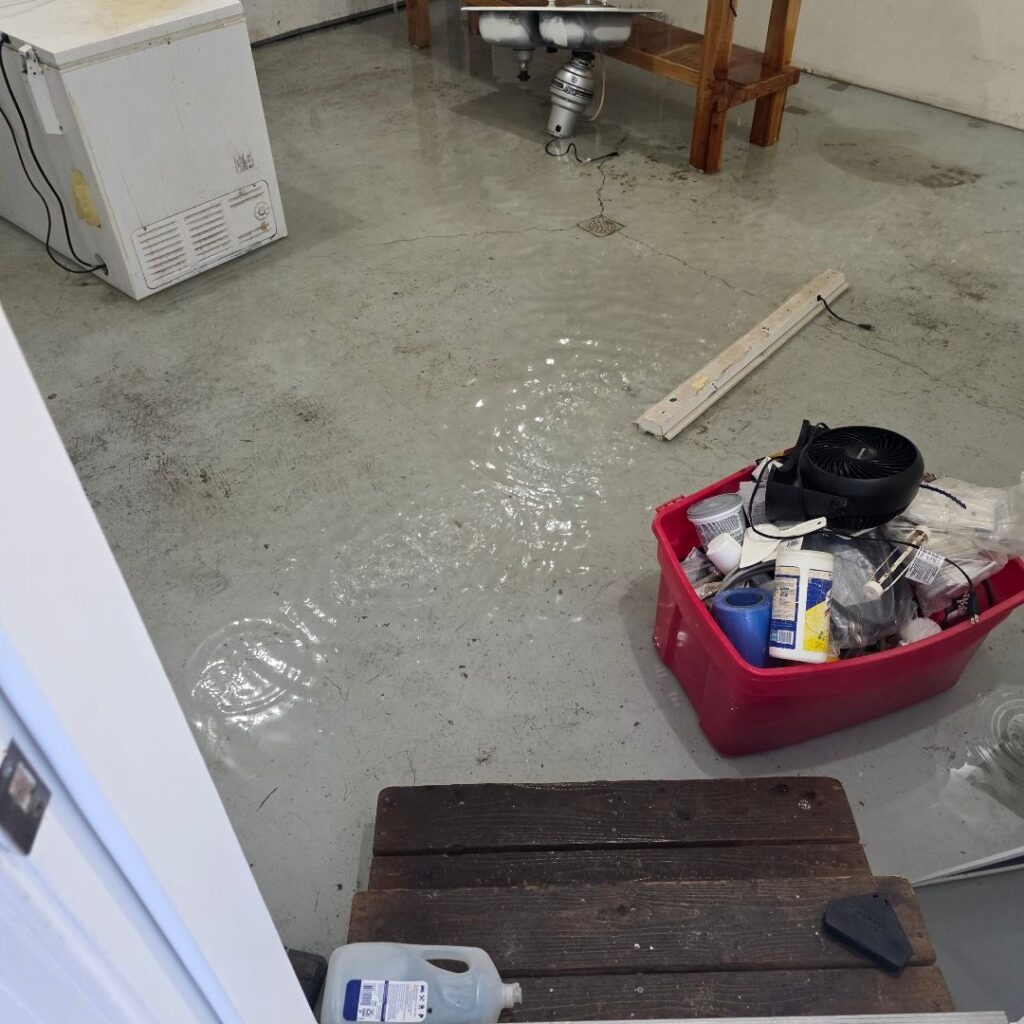
A frozen pipe burst in January is not the same job as a dishwasher hose failing in July. The water behaves differently, the building behaves differently, and half the standard playbook has to be adjusted for temperatures that stop evaporation altogether. Anyone who has run frozen pipe burst water damage work in this state for a few decades knows the difference is not academic.
Here is what actually changes, and why it matters to how the cleanup runs.
The pipe rarely breaks where the ice is
People assume the ice splits the pipe. Usually it does not.
What happens is that an ice plug forms, typically in a section of line running through an exterior wall, an unheated crawlspace, a garage, or an addition that was framed without much thought about the plumbing. Water expands as it freezes, but the expansion pushes liquid water along the pipe away from the plug. If a closed faucet or valve stops that water somewhere downstream, pressure builds in the trapped section until the pipe splits.
That means the break is often several feet from the frozen section, sometimes in a different part of the house entirely. It also explains the most common sequence people describe on the phone: no water from a tap, then hours later, water pouring through a ceiling once the plug thawed and pressure was released through the split.
Where it happens in Anchorage houses
The same handful of locations, year after year.
Supply lines run through exterior wall cavities, particularly on the north and windward sides where the wall never sees sun and wind strips heat from the sheathing. Crawlspaces where a vent was left open in autumn or a skirt panel blew off. Garages holding a water heater, where the overhead door lets in a wave of cold every time it opens. Unheated additions and enclosed porches plumbed at some point without anyone insulating the run. Cabins and vacation properties left on a setback thermostat. And houses whose owners went south for two weeks in January and turned the heat down to save on fuel.
The last category produces the worst losses, because nobody is there. A supply line running unattended for a week puts an extraordinary volume of water through a structure.
Discovery is late, so the loss is large
Summer failures usually get noticed within minutes because someone is in the room. Winter failures happen in cavities, crawlspaces and empty houses, and the water has often been running for hours or days.
That changes the first assessment. On a late discovery loss, the assumption is that water has migrated well beyond the visible area: along the underside of subfloor, down wall cavities, into insulation, under flooring assemblies and into any lower level. Moisture mapping with meters and thermal imaging is not an optional refinement on this kind of job. That gap between visible and actual is the point of hidden moisture rather than visible water.
Cold structures do not dry
This is the biggest practical difference and it catches people out.
Evaporation is temperature dependent. Below roughly 40 degrees Fahrenheit, useful evaporation from building materials effectively stops, and refrigerant dehumidifiers lose efficiency badly as air temperature falls. A crawlspace sitting at 25 degrees is not drying, no matter how many air movers are pointed at it. It is simply cold and wet.
So the sequence in winter has an extra step in front of it. Heat the space first, hold it, then dry it. That may mean temporary heaters, sealing crawlspace vents that are letting outside air in, or building containment around a work area so the heat stays where it is needed rather than escaping into the rest of the building.
The compensating advantage is real. Outside air in an Anchorage winter carries almost no moisture, and heated indoor air routinely runs down in the teens for relative humidity. Once a space is warm, that dryness works hard for you. The same job in July, with damp summer air moving through the building, takes longer.
Ice in the structure
On a genuine cold weather loss, some of the water is not water. It is ice: in a crawlspace, under vinyl or laminate flooring, inside a wall cavity, sometimes as a sheet across a garage floor.
Ice cannot be extracted. It has to be melted first, which means the space needs heat before the extraction stage rather than after it. Skipping that and declaring a floor dry is how a job gets closed on Tuesday and reopened on Friday when the frozen layer under the flooring finally melts.
There is a second risk. If a structure is warmed to melt ice and drying then stalls, or heat is turned off overnight to save fuel, water can refreeze inside the assembly. Freeze and thaw cycling inside a wall does mechanical damage that the original leak did not.
Insulation and vapor barriers
Alaska construction is heavily insulated, and that changes the job.
Wet fiberglass batt loses most of its thermal performance and does not recover by drying in place inside a closed cavity, because the cavity has no airflow. Standard restoration practice is removal of saturated batt rather than an attempt to dry it, and that decision usually comes early.
Vapor barriers are the other complication. A polyethylene barrier on the warm side of a wall does exactly what it was designed to do: stop moisture moving through the assembly. When the water is already inside the assembly, that barrier now traps it. Drying a wall with an intact vapor barrier often requires opening the assembly deliberately, because there is no path for moisture to leave otherwise.
Crawlspace ground barriers behave the same way. Water that gets on top of a ground barrier sits there and has nowhere to go, and a crawlspace that stays wet under a house is the beginning of a much longer problem.
What the cleanup sequence looks like
Shut off and drain the system. Assess for electrical hazard. Document everything before anything moves. Establish heat in the affected spaces. Melt and remove ice. Extract standing water. Map moisture with meters, including reference readings in unaffected areas of the same materials. Remove what cannot be dried in place, generally saturated fiberglass batt and materials that hold water without releasing it. Open assemblies where a vapor barrier blocks drying. Set containment, air movers and dehumidification. Record daily readings until documented dry standards are met.
Typical equipment time on a winter loss runs longer than the three to five days people expect from a summer job, because heating the structure is part of the schedule rather than a given. Crawlspace work in particular can extend well beyond a week.
Preventing the next one
Keep the house above 55 degrees Fahrenheit even when empty. Fuel is cheaper than restoration.
Open cabinet doors under sinks on exterior walls during cold snaps so heated room air reaches the pipes.
Let a faucet on the most vulnerable run drip during extreme cold. Moving water is much harder to freeze, and a dripping tap relieves the pressure that actually splits pipes.
Close crawlspace vents before freeze up and check that skirting is intact after the first serious wind.
Disconnect hoses from outdoor bibs in autumn, and shut and drain the bib if it is not frost free.
If the house will be empty for more than a couple of days in winter, have somebody check it. Ask them to look for the absence of things: no sound of running water, no unexpected cold spot, no taps that have stopped producing.
If a pipe has already gone, the immediate steps are in what to do with water damage, and our emergency work runs through flood and water restoration. The repair phase afterwards sits under flood damage repair and restoration, and more of our restoration writing is collected in the restoration archive. We have been responding to winter losses in this city since 1976, and you can read more about that on our water damage response page or reach us here. The number is (907) 215-2503.
Frequently asked questions
Where does a frozen pipe usually burst?
Often several feet away from the ice, not at it. The plug forces water along the pipe, and where a closed valve or faucet traps that water, pressure builds until the pipe splits. That is why the break can be in a different room, or a different level, from the section that froze.
Why did the leak only appear after the pipe thawed?
Because the ice plug was sealing the split while it was frozen. Once the plug melts, the system is pressurized again and water comes out of the break. A tap that has stopped producing during a cold snap is a warning, and the release is the event to prepare for.
What temperature should an empty Anchorage house be left at in winter?
Above 55 degrees Fahrenheit as a working minimum, with cabinet doors open on exterior wall plumbing and somebody checking the property if it will be empty for more than a couple of days. Deeper setbacks save a small amount of fuel and create a large amount of risk.
Does wet insulation need to be replaced?
Saturated fiberglass batt in a closed cavity is normally removed rather than dried, because it loses thermal performance when wet and the cavity has no airflow to dry it. That is a standard restoration decision and it usually gets made early rather than after a failed drying attempt.
Can drying be done in an unheated crawlspace in winter?
Not effectively. Below roughly 40 degrees Fahrenheit evaporation from building materials essentially stops and dehumidifier performance drops away. The space has to be warmed and held warm, with vents sealed and containment in place, before drying equipment achieves anything.