

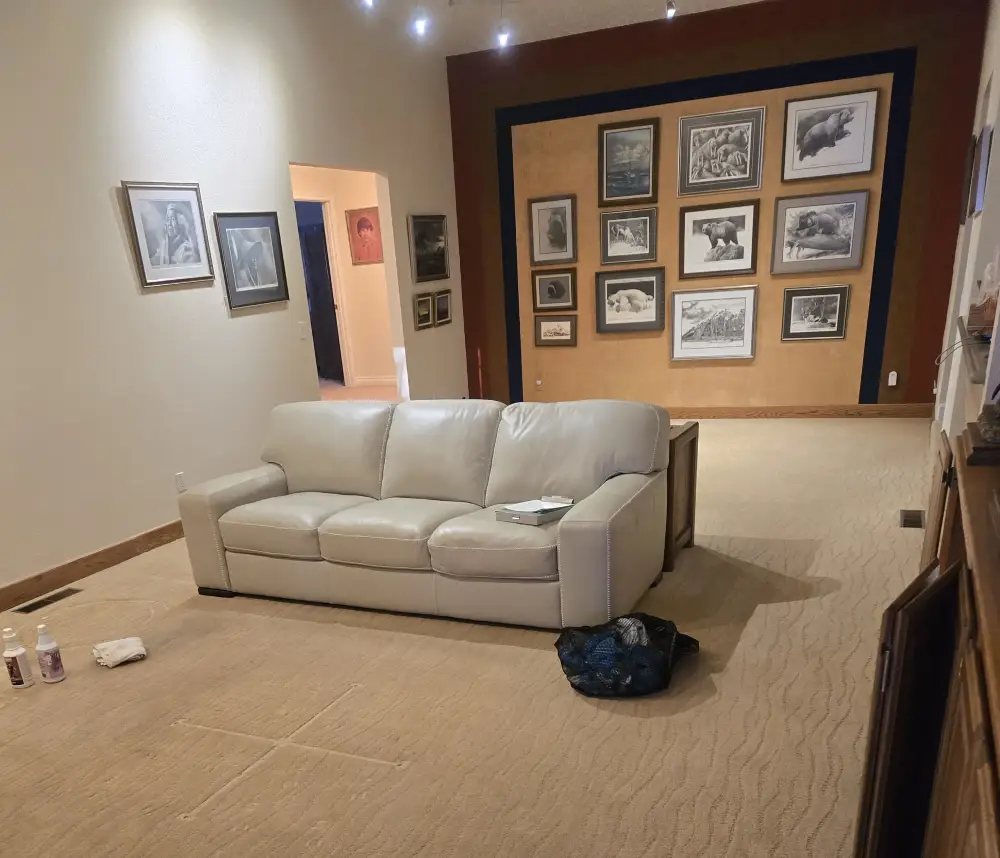
Leather furniture care is mostly a summer topic everywhere else in the country. Here it is a winter topic, because the six months between October and April are when the damage happens, and it happens quietly enough that nobody notices until a seat cushion starts cracking along its front edge.
The general rules for cleaning a leather sofa are covered in the dos and donts of leather sofa cleaning. This piece is narrower on purpose: what heating season air does to a hide, where the heat sources in an Anchorage house cause the most harm, and what conditioning can and cannot fix.
What is actually happening to the hide
Leather is a matrix of collagen fibers, and during tanning it is treated with oils and lubricants that let those fibers slide against each other instead of locking together. That flexibility is the whole point. It is why leather drapes and creases rather than snapping.
Two things degrade it. The lubricants migrate and deplete over years of use and heat. And the hide loses moisture to dry air, which stiffens the fiber matrix.
A stiff hide that gets flexed cracks. That is why the damage always appears in the same places: the front edge of a seat cushion where it folds under weight, the top surface of the arms, and the fold at the base of the seat back. Those are the flex points. The panel nobody sits on will still look fine.
Why an Anchorage winter is hard on it
Indoor relative humidity in a heated home here regularly drops into the teens through the coldest months. That is drier than most desert climates, sustained for months, in a room where the furniture cannot move away from it.
Then there are the heat sources, and their arrangement matters more than the overall room temperature.
Wood stoves. The most common serious offender in Anchorage homes. Radiant heat from a stove is not the same as warm room air. It dries the surface of a hide directly and unevenly, so the side of the sofa facing the stove ages years faster than the other side. Three feet away is too close.
Forced air registers. A register discharging under or directly at a sofa moves a continuous stream of very dry warm air across one part of the piece. Redirecting a diffuser is a five minute job that saves a cushion.
Baseboard heaters. Common in older Anchorage housing, frequently running along the wall a sofa is pushed against. Leave a gap.
Low winter sun. The sun sits low here and comes through south and west facing glass at a shallow angle, so it reaches much deeper into a room than summer sun does. Direct sunlight fades and dries leather, and in winter it reaches furniture that is nowhere near the window.
Know which leather you have
The care differs and so does the risk.
Pigmented or protected leather. A surface coating over the hide, most common on family furniture. Durable, more forgiving of cleaning, and the coating itself can crack independently of the hide underneath.
Semi aniline. A light protective coat over a dyed hide. Softer feel, more natural appearance, less forgiving.
Aniline. Dyed through with no protective coating. The best looking and the most vulnerable. It absorbs liquid readily, marks easily, and it is the type most damaged by dryness.
Nubuck and suede. Napped surfaces, cleaned by entirely different methods, and never with liquids at home.
Bonded leather. Not leather in the way people assume. Shredded hide fiber bonded with polyurethane, and it fails by peeling and flaking rather than by cracking. Conditioner does nothing for it, because there is no hide surface to condition. Nothing recovers it once it has begun to peel.
Testing which you have is done in a hidden area, on the back or underside, never on a visible panel. On aniline a single drop of water darkens and absorbs. On pigmented leather it sits. Do the test where a mark will not matter, because on aniline it may not disappear.
Conditioning: what it does and does not do
A conditioner replaces some of the lubricants that keep the fiber matrix flexible. On a hide that is dry but sound, it genuinely helps, and it is the single most useful thing you can do for leather furniture in this climate.
What it cannot do: repair cracks, restore a hide that has dried past the point of flexibility, or fix a cracked surface coating on pigmented leather. Those are repair jobs, and a coating crack is a different problem from a hide crack even though they look similar.
Twice a year is a reasonable baseline in an Anchorage home, and quarterly is not excessive for a piece sitting near a wood stove or in winter sun. Test any product in a hidden area first and let it dry fully before judging the result.
Avoid products containing silicone, petroleum distillates or waxes on protected leather, because they build a film that attracts soil and can interfere with any later repair. Saddle soap belongs on tack, not on furniture leather, and it is alkaline enough to strip finishes. Baby wipes are the most common accidental damage we see: the surfactants and alcohol in them remove the surface coating gradually, and the result shows up as dull patches exactly where people habitually wipe.
Routine care through the heating season
Dust weekly with a dry soft cloth. Dust is abrasive and it collects in the grain.
Vacuum the crevices with a soft brush attachment, particularly where cushions meet the frame. Winter grit brought in on clothing settles there and works into the seams.
On pigmented leather, wipe with a barely damp cloth and dry immediately. On aniline and semi aniline, be considerably more cautious, because water marks.
Deal with spills at once by blotting, never rubbing. Rubbing spreads the liquid and, on absorbent leather, drives it in.
Rotate loose cushions so wear and exposure distribute rather than concentrating on the seat somebody prefers.
The winter specific hazards
Hand lotion. People use far more of it here in winter, and lotions transfer to arms and headrests, where they can react with the finish over time. That soft shine on the arm of a sofa is often lotion, not wear.
Throws and blankets. In heavy use from October onward, and dark or newly washed textiles can transfer dye onto light leather, particularly if the leather surface is warm.
Wood stove residue. Fine soot settles on everything and shows first on light colored leather, dulling it long before anyone would call the sofa dirty.
Salt on clothing. Brine on trousers and coats transfers to seat surfaces, and dried salt is both abrasive and hygroscopic.
Pets, which are indoors a great deal more from November through March. Claw marks in a coating cannot be undone at home.
Humidity, honestly
The commonly cited comfortable range for leather is somewhere around 40 to 50 percent relative humidity. Achieving that in an Anchorage house in January is difficult, and pushing hard toward it creates its own problems, because excess indoor moisture in a cold climate condenses inside wall assemblies and on windows.
So the realistic goal is not a number. It is to avoid the extremes and to control the local conditions around the furniture: keep pieces away from direct heat, redirect registers, pull furniture back from stoves and baseboard heaters, and use window coverings against low winter sun. A modest humidifier run sensibly helps. Condensation running down the windows means you have gone too far.
When it has already cracked
Honest answer: it depends which layer cracked. A cracked surface coating on pigmented leather can sometimes be addressed by a leather repair specialist. Cracks through the hide itself cannot be reversed, and anybody promising otherwise is selling something.
What conditioning does at that stage is slow the progression and keep the surrounding area flexible, which is worth doing even when the damaged section will not improve.
Our upholstery cleaning service covers leather as well as fabric, and the broader ground on soft furnishings is in everything you need to know about upholstery cleaning. For fabric pieces in the same room, fabric protection works on a different principle but with a similar aim. More upholstery writing sits in the upholstery archive. To have a piece assessed before winter, schedule a service visit.
Frequently asked questions
How often should leather furniture be conditioned in Alaska?
Twice a year is a reasonable baseline for a heated Anchorage home, and quarterly is sensible for a piece near a wood stove, a forced air register or in the path of low winter sun. Test any product in a hidden area and let it dry completely before treating the whole piece.
What indoor humidity is best for leather furniture?
The commonly cited range is around 40 to 50 percent, which is difficult to sustain in an Anchorage winter and can cause condensation problems in a cold climate house if pushed too hard. A more practical approach is to avoid the extremes and control conditions around the furniture itself by moving it away from direct heat sources.
Can I use baby wipes or saddle soap on a leather sofa?
Neither. Baby wipes contain surfactants and alcohol that gradually remove the surface coating, producing dull patches where people habitually wipe. Saddle soap is formulated for tack and is alkaline enough to strip furniture finishes. Use a product made for furniture leather, tested in a hidden area first.
Why is my leather sofa cracking on the front edge of the seat?
Because that is a flex point. Dry air stiffens the fiber matrix in the hide, and a stiff hide that gets bent repeatedly cracks where it bends. The same happens on the tops of arms and at the fold of the seat back, while panels nobody touches stay intact.
How far should leather furniture be from a wood stove or heater?
Further than most people place it. Radiant heat dries the surface of a hide directly and unevenly, so the side facing the source ages considerably faster. Three feet is too close to a stove. With forced air, the more effective fix is often redirecting the diffuser so the stream is not crossing the furniture at all.