

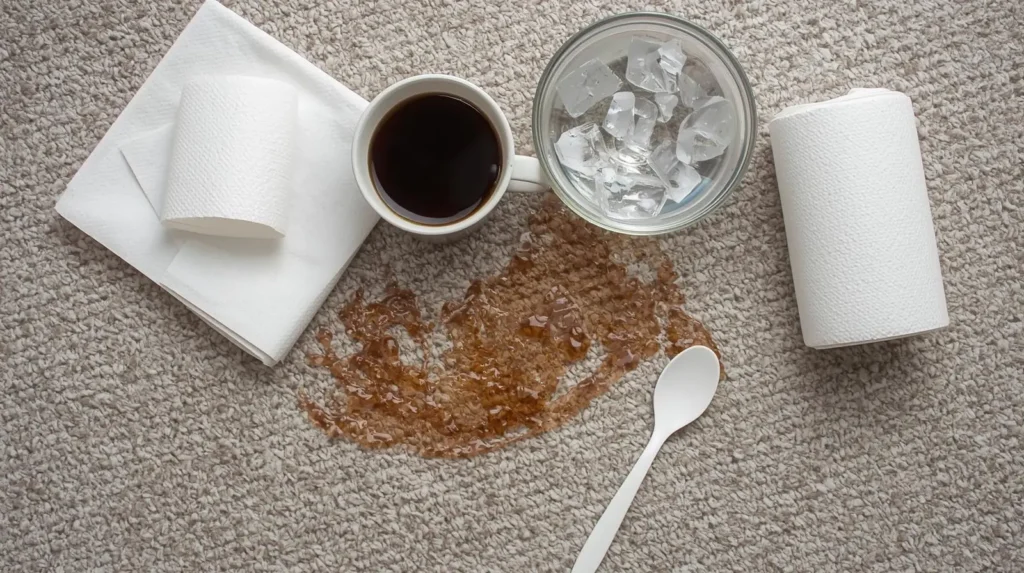
Most carpet “stains” become permanent because of two mistakes: rubbing and over-wetting.
A spill is a race between absorption (liquid moving downward) and removal (you lifting it out). If you handle the first five minutes correctly, you can often prevent a permanent mark and avoid the lingering odor that shows up days later.
This guide gives a practical, low-risk, step-by-step process for how to clean carpet at home after three common spill types—coffee, soda, and greasy food—with instructions that prioritize fiber safety, minimal residue, and fast drying.
Before you touch the stain: the 60-second setup that prevents damage
You don’t need a cabinet of products. You need the right sequence.
What to grab
- Plain white paper towels or clean white cotton towels (avoid dyed towels)
- Two bowls (one for clean water, one for “dirty blotting”)
- Cool water (not hot)
- A spoon or dull edge (for lifting solids)
- A vacuum (only after the spot is dry)
- Optional but helpful: a spray bottle for water
Two rules that keep you from making it worse
- Do not rub. Rubbing drives the spill deeper and distorts carpet fibers, creating a fuzzy “permanent” patch.
- Do not flood. Over-wetting pushes the spill into the backing and padding, leading to odor, wicking, and slow drying.
The universal spill playbook
No matter what you spilled, start here.
Step 1: Remove solids gently
If there are chunks (food, sauce, cream), use a spoon or dull edge to lift them off. Do not smear. Work from the outside toward the center.
Step 2: Blot immediately—pressure, not friction
Place a folded towel over the spill and press down firmly. Hold for 5–10 seconds, lift, repeat.
You’re using compression to pull liquid up into the towel.
Keep blotting until the towel stops picking up liquid.
Swap to a clean section of towel each time—reusing a saturated towel just puts liquid back.
Step 3: Lightly mist with cool water (only if needed)
If the spill has already started drying or is sticky, lightly mist a small amount of cool water. The goal is to dilute the remaining spill, not soak the carpet.
Step 4: Blot again until transfer stops
Repeat the press-and-lift cycle until there’s little to no transfer onto the towel.
Step 5: Dry the spot fast
Place a clean, dry towel over the area and press down with your body weight for 30–60 seconds to pull out as much moisture as possible.
Then help it dry quickly:
- Aim a fan across the carpet (sideways airflow works better than blowing straight down).
- If you have one, run a dehumidifier in the room.
- Keep people off the area until it feels completely dry, not just “dry on top.”
Done right, this drying step prevents most odor and “stain came back” problems.
Coffee spills: remove tannins without setting the stain
Coffee is tricky because it contains tannins (color compounds) that can bind to fibers, especially if heat is involved.
Step-by-step for coffee
Step 1: Blot immediately using the universal playbook (above).
Don’t wait. Coffee sinks fast.
Step 2: Use cool water—not hot
Hot water can make tannins bind more aggressively. Lightly mist cool water and blot.
Step 3: Repeat small dilution cycles instead of one big wetting
Do 3–6 small cycles:
- Mist lightly
- Press and blot
- Switch towel sections
This gradually lifts color without soaking the backing.
Step 4: Watch for “ringing” (halo edges)
A halo forms when you wet a wider area and push dissolved coffee outward. Keep your moisture controlled and blot from outside inward.
Step 5: Dry thoroughly
Coffee odor can linger if the area stays damp. Use airflow until the carpet is dry to the touch.
If coffee had cream or sugar
That’s no longer just tannins—it’s proteins and sugars too. Those residues can turn sticky and cause re-soiling later. The key is extra thorough blotting and controlled dilution to remove residue rather than just spreading it.
Soda spills: deal with sugar residue so it doesn’t attract dirt
Soda is less about dye (unless it’s dark cola) and more about sugar. Sugar dries into a sticky film that collects soil fast—so the spot can look “fixed” and then turn dirty again.
Step-by-step for soda
Step 1: Blot immediately
Focus on lifting as much liquid as possible before you add any water.
Step 2: Dilute the sugar gradually
Use light misting and repeated blotting cycles. The goal is to remove the syrupy film.
Step 3: Keep going even after the color looks gone
This is where people stop too early. If the carpet feels even slightly tacky once dry, sugar residue is still there.
Step 4: Final water-only rinse pass (small)
One last light mist with cool water and a thorough blot can reduce leftover residue.
Step 5: Dry fast
Sugar plus slow drying is a recipe for odor and rapid re-soiling.
Dark soda and cola
Cola can leave color behind if it dries. Treat it like coffee:
- Blot
- Cool-water dilution cycles
- Don’t flood
Greasy food spills: stop the oil from spreading
Grease behaves differently than coffee or soda. Oils bond to fibers and can spread outward if you add too much water too soon.
Step-by-step for greasy food
Step 1: Lift solids first
Use a spoon to remove anything you can without smearing.
Step 2: Blot gently—don’t press too hard at first
With grease, aggressive pressure can spread oil laterally. Start with moderate pressure and repeat.
Step 3: Do not pour hot water on it
Heat can make oils more mobile, spreading the stain.
Step 4: Use a tiny amount of water and blot—don’t soak
Light misting can help remove associated sauces, but oils won’t lift with water alone.
Step 5: Expect this to take longer
Grease stains often require careful, repeated removal attempts. If the area darkens after drying, oil remains in the fibers.
Why greasy spots “come back”
That’s usually not a return—it’s wicking or oil migration. If the backing or deeper fibers hold oil, it can move upward as the carpet dries.
Preventing wicking: the hidden reason stains reappear tomorrow
Wicking is when the spill penetrates deeper than you removed, and as moisture evaporates, it pulls dissolved residues upward. The spot looks fine at first, then a stain “returns.”
To reduce wicking:
- Use minimal moisture
- Do more blotting cycles, fewer wetting cycles
- Do a strong final dry press
- Keep airflow moving until fully dry
If the carpet is still cool and damp underneath, it isn’t truly dry. That’s when wicking happens.
What not to do: the fastest ways to permanently damage carpet
Avoid these if you want the carpet to look normal afterward:
- Scrubbing with a brush: frays fibers and creates a fuzzy, light-reflecting patch
- Using too much soap: leaves residue that attracts dirt and makes spots reappear as “dirty”
- Over-wetting: soaks the backing/pad, causing odor and wicking
- Using bleach or harsh oxidizers casually: can discolor dye and weaken fibers
- Covering a damp spot with a mat: traps moisture and can lock in odor
When “how to clean carpet at home” stops being realistic
Some spills are beyond surface cleanup, especially if they reach the padding. Here are signs the spill likely went deeper:
- The spot keeps returning after it dries (persistent wicking)
- The carpet smells sour, musty, or “off” days later (residue + moisture)
- The area feels stiff or crunchy (detergent or spill residue)
- The spill was large enough to saturate beneath the surface
- Grease remains as a dark patch even after careful blotting
That doesn’t mean the carpet is ruined—but it does mean surface-only cleaning may not remove what’s underneath.
The most effective home approach after a spill is boring but consistent: blot, dilute carefully, blot again, and dry fast. Most damage comes from panic-cleaning—scrubbing, soaking, and dumping products that leave residue.
If you treat the spill like extraction—not like scrubbing—you’ll avoid the two biggest long-term problems: wicking and sticky re-soiling.