

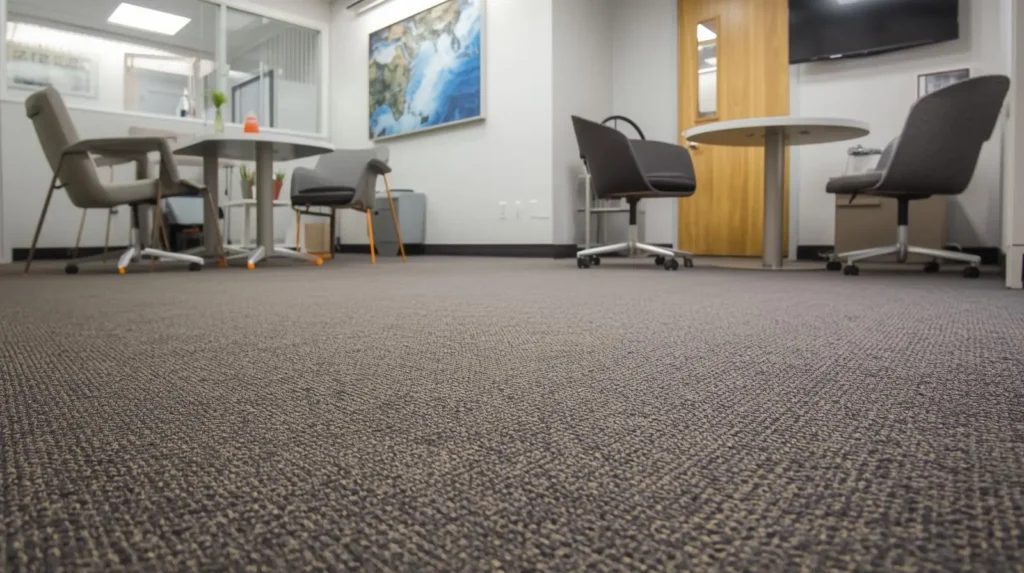
Office odors don’t come from “the air.” They come from surfaces—especially carpet—holding onto residues that keep feeding smells over time.
Break rooms, coffee stations, reception areas, and shared hallways are where office carpet gets hit with a nasty mix: coffee, creamer, sugar, syrups, microwave food aromas, tracked-in moisture, and whatever people spill and “clean” with a random spray from under the sink. The result is a familiar cycle: the carpet gets cleaned, smells fresh for a day or two, then the odor comes back—sometimes worse.
This post breaks down how office carpet cleaning can actually reduce odors in common areas without over-wetting, why some cleaning methods make smells linger, and what professional-grade cleaning does differently to remove odor sources instead of masking them.
Why carpet odors keep coming back in offices
Most office carpet odors are not one-time events. They’re recurring chemistry problems caused by residue and moisture.
Residue is the real odor trap
Carpet fibers and backing can hold onto:
- Coffee and tea tannins
- Dairy proteins and fats from creamer
- Sugary syrups and soft drinks
- Food oils and grease aerosol (yes, it travels)
- Cleaning product residue (especially high-foam sprays)
These residues don’t just “sit there.” They bind soil, stay slightly tacky, and keep collecting new particles. Over time, that mix becomes a slow-release odor source.
Moisture turns residues into a smell factory
Odors tend to intensify when carpets stay damp too long. In break rooms and common areas, dampness can come from:
- Tracked-in snow and slush
- Spills that soak into the backing
- Over-wet spot cleaning
- Poor extraction during professional cleaning
- Humidity + low airflow in enclosed spaces
The longer carpet stays damp, the greater the chance that odors develop or worsen—especially in areas with organic residues (food and drink).
Masking sprays make the problem harder later
Many off-the-shelf deodorizers don’t remove odor sources; they layer fragrance over residues. Some leave behind their own sticky film, making the carpet resoil faster and trapping more odor-causing material.
If your carpet smells “clean” but then turns sour or stale again, the odor source wasn’t removed—it was temporarily covered.
What “over-wetting” really is and why it’s so common
Over-wetting isn’t just “using too much water.” It’s putting more moisture into the carpet system than you can remove quickly.
In offices, this often happens when:
- Someone repeatedly pours cleaner on a spot and scrubs
- A carpet is cleaned with too much solution and weak extraction
- The same area gets hit over and over (coffee station, trash area)
- Furniture and mats block airflow so moisture stays trapped
Over-wetting becomes a problem because carpet is a layered system: face fibers, backing, sometimes adhesive, and the subfloor beneath. Moisture can migrate downward and spread outward, which is why a small spill can become a broader odor zone later.
The odor hotspots in break rooms and common areas
If you want odor control that lasts, you target the zones that behave differently:
Coffee stations and beverage areas
This is where sugar, dairy, and syrups create sticky residues that trap grime. If you’ve ever noticed a faint “sweet-sour” smell around a coffee counter, it’s often residue in the carpet, not the trash can.
Microwaves and eating areas
Food oils and grease aerosols settle onto nearby surfaces. Over time, that film can bind dust and produce a stale odor that feels like “old lunch.”
Trash zones
Leaks happen. Even when there’s no obvious spill, bag drips and tiny leaks build up. Odor gets pushed into the carpet by foot traffic.
Entry paths to break rooms
These lanes combine tracked-in moisture with food residue. That combination increases the risk of persistent odor because damp grit and organics are being ground in repeatedly.
What actually removes odors during office carpet cleaning
Odor removal is not a single step. It’s a controlled process designed to eliminate the source and leave the carpet neutral—not perfumed.
1) Start with dry soil removal to prevent “mud cleaning”
Before any moisture hits the carpet, dry particulate needs to come out—especially in Anchorage where tracking can load carpets with fine grit. If you add water first, grit turns into slurry that’s harder to remove and can push residues deeper.
2) Use targeted pre-treatment where odors live
A break room carpet isn’t the same as a hallway carpet. The chemistry has to match the soil type:
- Beverage residues need chemistry that breaks down sugars and proteins
- Oily food residues need chemistry that releases oil films
- General traffic lanes need soil suspension without leaving residue behind
Targeted pre-treatment matters because odors are typically concentrated in small zones—coffee stations, under tables, near trash, and along specific lanes—not uniformly across the floor.
3) Agitation is how you separate residue from fiber
Odor-causing residues cling to fibers. Lightly working pre-treatment into the carpet helps break that bond so the next step—extraction—can actually remove it instead of just diluting it.
4) Extraction must remove what was loosened
This is where many “carpet cleanings” fail. If the process loosens soil and odor residue but doesn’t recover it effectively, the carpet can smell worse later because:
- Moisture remains,
- Residue remains,
- And as it dries, wicking can bring contaminants back toward the surface.
Real extraction success looks like:
- Controlled moisture application,
- Strong vacuum recovery,
- Additional dry passes where needed,
- Zone-by-zone focus on odor areas.
5) Residue control prevents the odor from rebuilding quickly
If detergent residue is left behind, it attracts new soil and accelerates odor return. The goal is a finish that leaves the carpet clean but not “sticky,” so new grime doesn’t latch on as fast.
How professionals reduce odors without soaking the carpet
A common misconception is: “To remove smell, you need to flood it.” That’s backward.
The better approach is:
- Minimize moisture while maximizing soil removal
- Extract aggressively so the carpet dries faster
- Clean in zones to control drying and keep airflow available
- Use airflow management after cleaning in odor-heavy areas
In real offices, break rooms often have less airflow than open workspaces. That means drying strategy matters more, not less.
Practical drying controls include:
- Not cleaning the entire common area at once if airflow is limited
- Keeping vents unobstructed
- Avoiding leaving damp carpet trapped under mats or furniture
- Using moving air in the worst odor zones until they are genuinely dry
The “cleaned and now it smells worse” problem
If an office complains that carpet smells worse after cleaning, the cause is usually one of these:
Wicking: contaminants rise as the carpet dries
When moisture penetrates deeper than the extraction can recover, dissolved residues can migrate upward. That can bring old odors back to the surface—now more noticeable because the top layer is clean.
Too much moisture + not enough airflow
Dampness that lingers turns mild residues into strong odors. If carpet stays wet in an enclosed break room, the smell may spike as it dries slowly.
Residues were diluted, not removed
If the cleaning process wasn’t strong enough to remove the bonded residues, it can loosen them just enough to make odors more apparent—without actually extracting them.
A good odor-control cleaning prevents these outcomes by controlling moisture, strengthening extraction, and focusing on the real hotspots.
Office-safe spot handling that prevents odor buildup
Most odor issues are made worse by well-intentioned spot cleaning. Here’s what typically causes problems:
- Pouring cleaner directly onto carpet repeatedly
- Scrubbing hard and spreading residue
- Leaving detergent in place without rinsing or extracting
- Over-wetting the backing so it never fully dries
A safer approach that avoids odor buildup:
- Blot spills immediately (don’t grind them in)
- Use minimal product and minimal moisture
- Blot again to remove residue
- Avoid leaving fragrance-heavy products behind
Even if the spot looks gone, residue left behind can become the next odor source.
Making break room carpet odor-resistant over the long term
Odor reduction isn’t just one cleaning; it’s consistency in the right places.
What stabilizes results in offices:
- Treating coffee stations and trash zones as high-priority cleaning areas
- Maintaining entry mats so moisture and grit don’t reach break room lanes
- Addressing small spills quickly with low-residue methods
- Avoiding repeated over-wet spot cleaning cycles
The point is not to “sanitize the carpet every week.” It’s to remove residues before they get embedded, and to keep drying times fast enough that smells don’t develop.
A closing note on odor control that actually lasts
Office odors in carpets are solvable when cleaning focuses on removing residues, not covering them up. The most reliable path is disciplined office carpet cleaning that prioritizes dry soil removal, targeted pre-treatment, effective agitation, thorough extraction, residue control, and fast drying—especially in break rooms and common areas where spills and food residues are constant.
When carpets dry quickly and residues are truly removed, the odor cycle breaks—and the office stops getting that recurring stale smell that makes the whole space feel unclean.